
As the class of 2026 gets closer to graduation, they are also preparing for a multitude of job interviews. This can feel scary and overwhelming, especially for inexperienced interviewees. This advice from MBU staff members will help job-seekers stress less and adequately prepare.
Job interview– two words that make many people cringe in fear, especially college students nearing graduation.
Many questions will likely arise in a student’s mind: How do I prepare? How do I appear professional? Why am I not getting a job right away?
MBU professionals answered some of these questions and shared their personal tips.
Joel Lindsey, director of university communications at MBU, has conducted a number of job interviews for his department.

He emphasized that a solid resume is essential and does not need to be complicated.
“Have a good resume. … Look and see what’s out there in terms of what format you use. I would say simpler is better,” said Lindsey. “Incorporate some of the stuff maybe from your educational and academic experience, maybe you don’t have a lot of job experience, but you’ve taken some classes, you’ve done some internships, you’ve been a student worker, even volunteer kind of stuff– use all of that and tailor that description.”
He also expressed that having a good attitude and seeking others’ help is advantageous.
“Just go in with confidence, and have other people who maybe have more experience look at your resume and offer tips,” said Lindsey. “When we write our own stuff down, sometimes we’re so close to it we don’t catch mistakes. Look for typos, proofread it, really make it look professional.”
Lindsey’s next tip is “dress for success.”
“It’s always better to dress up, rather than to dress down,” said Lindsey.
Interviewees should aim to look like they belong.
“Go to the website of the company that you’re applying for, and look at what the images look like,” said Lindsey. “If everybody’s business casual, go slightly elevated business casual. … Whatever you see on their website is kind of who they’re reflecting themselves to be, and you want to look like you fit in there.”
It’s important to remember that a full-time job will consume lots of time, and time is precious.
“It’s not just you that’s getting interviewed. You’re interviewing them,” said Lindsey. “You’re in the position of maybe needing a job … but be picky. … Make sure it’s a place that you want to get up and go to work at every day, because 40-plus hours a week is a lot of your time.”
Interviewees will have to face behavioral questions– the daunting questions that begin with, “Tell me about a time when…”.
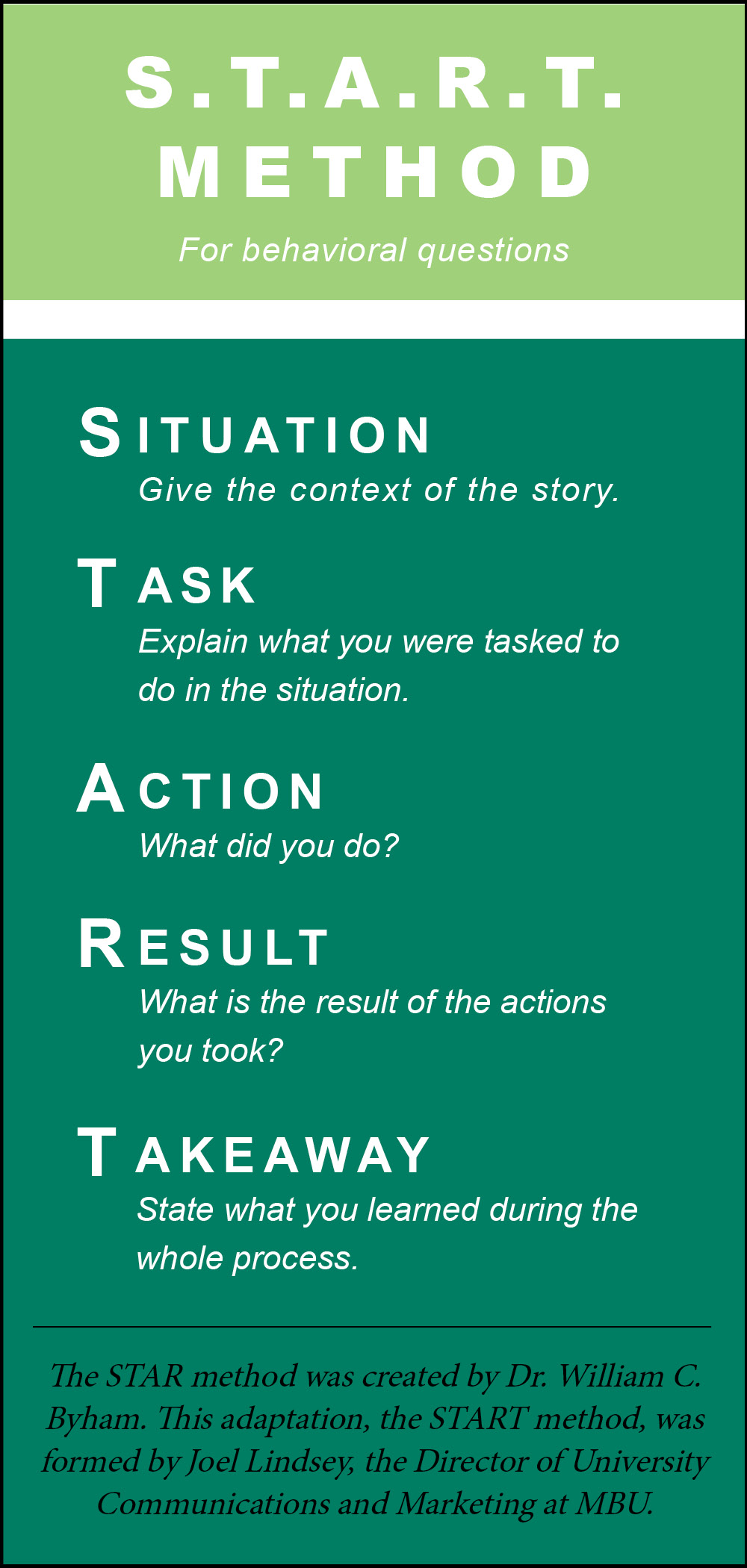
Lindsey gave the helpful recommendation of using the ‘STAR’ method to answer these questions, but he added another ‘T’, as explained in this graphic.
The START method is essentially a blueprint students can follow to answer behavioral questions, by explaining the situation, task, action, result and a takeaway from the situation.
Lindsey’s personal post-interview tip involves going against the modern standard.
“Handwrite a note, handwrite a card, and … get it to them within 24-48 hours. … That seems really thoughtful and kind of creative, like somebody that’s going to go above and beyond,” said Lindsey.
Rejection is a part of life, but a shift in perspective can make these moments more hopeful.
“Sometimes being told ‘no’ is actually a blessing in disguise. … In a Christian perspective, trust that God has got you, and maybe God’s protecting you from something that you don’t anticipate,” said Lindsey. “Maybe He has lessons for you to learn that can only be learned through rejection, so lean on Him. Lean on other people.”
“Maybe He has lessons for you to learn that can only be learned through rejection, so lean on Him. Lean on other people.” – Joel Lindsey
Just as Lindsey is an MBU professional with lots of interviewing experience, Sarah Marie Woodson is the director of career development at MBU, and she has helped many students feel more comfortable and prepared before they participate in a job interview.
Woodson has been at MBU for 19 years– 4 years as a college student and 15 years on staff – and has advice of her own.
Woodson recommended visiting the employee review website, Glassdoor.
“[Glassdoor] gives you more of a lens of how the employees view those companies,” said Woodson.
Students can gain valuable insight from reading Glassdoor reviews and trust that these statements reflect the honest opinions of individuals from a workplace.
Woodson recommended researching both the company itself and the interviewers.
“I would really recommend looking at their LinkedIn company page, but not only that, if you know who your interviewers [are], look at their personal profiles. Understand where they went to college. Understand how long they’ve been at that role,” said Woodson.
When it comes to an interview, employees love to see a well-prepared, enthusiastic candidate.
Joyce Montgomery is the director of human resources at MBU, and while she’s been at MBU less than two years, her 15 years of HR experience has shown her the ins and outs of job interviews.
Montgomery suggested researching a company before an interview with them.

“It’s very impressive when somebody comes into an interview and has researched the company. … How many employees do they have? What are their core values? What is their mission statement? What are the important things in that particular role?” said Montgomery.
Knowing this information can help students have confidence, as first-time interviews may feel especially nerve-wracking.
“People get nervous when they start going for an interview, especially if they’re not experienced at it,” said Montgomery. “If it’s your very first interview … get a hold of somebody in the career development office, and ask them if they can take you through some mock interviews.”
Montgomery has another helpful, yet very simple suggestion.
“Take a deep breath … two or three times before you go in the room,” said Montgomery.
Furthermore, Montgomery emphasized that there are various opportunities out there.
“This is just one interview. … If it works out, I’m happy. If it doesn’t, I know there’s something else out there,” said Montgomery.
While planning ahead can be beneficial, Woodson discouraged students from clinging too tightly to their own plans.
“I would encourage you guys just to have open hands … because you just never know what will happen next,” said Woodson.
Students can apply this tried-and-true advice from trusted MBU professionals, leaving them feeling prepared and empowered to take on a future of job interviews.