

The Bible provides timeless truths that can guide modern political engagement, especially within the framework of American conservatism. It connects each of the seven core conservative principles—such as individual freedom, limited government, rule of law, and human dignity—to supporting biblical teachings.
Ultimately, it concludes that Christian theology largely aligns with conservative values and that Christians should actively participate in political life grounded in biblical truth.
The Bible holds truth that has been written, unerringly, for over two millennia. Some may think that it has little relevance to the problems of today, when it holds greater light than ever in such a dark and tumultuous world.
While governments have risen and fallen, the everlasting Truth will guide a way so that individuals can be more aware and involved in their own political systems, whether liberal or conservative.
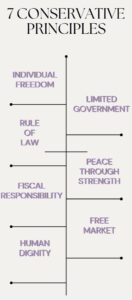
Thus, the aim of this assessment is to apply Biblical principles to the modern movement known as Conservatism. The seven core principles of conservatism, written by Mark Johnson of the U.S. Congress, are as follows: individual freedom, limited government, rule of law, peace through strength, fiscal responsibility, free markets, and human dignity.
 Individual freedom is our God-given individual rights. This can be traced to the foundation of American history and in the Declaration of Independence: we hold these truths to be self-evident, that all men are created equal, that they are endowed by their Creator with certain unalienable Rights, that among these are Life, Liberty, and the pursuit of Happiness.
Each person is made in the Image of God. God declares in the making of creation in Genesis 1:26, “let us make man in our own image.” No one is inferior. In fact, God calls us to live free.
Galatians 5:13 states, “For you were called to freedom, brothers. Only do not use your freedom as an opportunity for the flesh, but through love serve one another.”
Freedom is not a license to do anything one wishes. When God told Adam and Eve to be fruitful and multiply, fill the earth and subdue it, he did not give them license to extort evil in the name of good. No, as Paul puts it, “‘I have the right to do anything,’ you say—but not everything is beneficial” (1 Corinthians 6:12).
Limited government must be reduced if individual liberty is to thrive. Legitimate government operates only by the consent of the people and is better for all when it is less involved in the lives of the average citizen.
The United States was built on the belief that government should be for the people, by the people, and be exercised in conscientious authority.
Government in itself is not evil, for God has established it, for “every person should be subject to the governing authorities. For there is no authority except from God, and those that exist have been instituted by God” (Romans 13:1).
While the Bible does not explicitly state what role government should play, it can be inferred throughout Scripture that government is designed to resemble God’s authority and laws.
New Testament passages such as 1 Peter 2:13 imply that the government’s primary role is focused more on punishing evil and praising good behavior and less on providing goods and services. Again, although no particular model is espoused, let Scripture forever be the guide.
The rule of law is that no one is above the law, and that everyone is accountable to the laws of the land. God is a fair and just ruler. Time after time in the Old Testament, He holds his people accountable when they stray from His commandments.
Government then should emulate the same. Romans 13:4 states, “For he (government) is God’s servant for your good. But if you do wrong, be afraid, for he does not bear the sword in vain.”
Government will never be fully just and perfect, but there is a correlation between a just rule of law and the welfare of society. This is exemplified in Proverbs 29:2, “when the righteous increase, the people rejoice, but when the wicked rule, the people groan.” Ultimately, ”everyone will give an account of their lives to God” (Romans 14:12). The rule of law emulates an image of a just God.
Peace does not come to those who do not work for it. It is thus the responsibility of the nation first and foremost to maintain a defense that is strong to deter enemies abroad.
Two Bible verses may be cited here, Psalm 33:16‑17 which states, “The king is not saved by his great army; a warrior is not delivered by his great strength. … but the steadfast love of the LORD is from everlasting to everlasting on those who fear him,” and Psalm 29:11, which states, “The Lord gives strength to his people; the Lord blesses his people with peace.”
It is the Lord who brings peace; it is the Lord who defends a nation. It is not based on strength or might but in Jesus’ name. He may provide the gift of a strong defense, but it is ultimately God who maintains it.
This nation was built on Christian values, the revolutionary idea that humans had inalienable rights and all deserved justice and equality. Thus, it must first and foremost seek Christ, and then use the power that Christ has given it to secure the good of the people in it.
Fiscal responsibility is the management of goods and resources to promote sustainability. It is not wasteful; it is being prudent with the gifts that God has given.
The United States has not entirely been an example of fiscal responsibility for the national debt is over $38 trillion. God is a god of order and accountability.
In Luke 14:28‑30, He draws the illustration of a man “desiring to build a tower, who does not first sit down and count the cost … so that when he has laid a foundation and is not able to finish.”
This plays out in the Old Testament, too, as the God of planning and prudence states the specifications of the Temple, telling Moses how to group and govern the people, and so on.
Proverbs 21:20 states, “Precious treasure and oil are in a wise man’s dwelling, but a foolish man devours it.” We are called to not waste the gifts God has bestowed upon us, and to use the ones He has given us wisely and for His good. Fiscal responsibility aligns with the Biblical view of prudence.
Free market is the idea that government limits should be few, so that a society can thrive, innovate, and progress through the American dream. It is the idea that individuals know their situation better than the government.
The Bible never endorses or speaks of free markets, but it has much to say about prosperity and wealth. Passages like Ephesians 4:28 encourage honest work, while Proverbs 11:1 emphasizes fair weights and measures in commerce.
But in the beginning, God created us free. There were no governments and no bureaucrats. When the government tends to intervene, it can usurp individual freedom, intentionally or unintentionally. Freedom of the market will allow people to thrive naturally. All of this, however, should be in the context of loving our neighbor.
Finally, but not last, is the idea of human dignity. That all people have value and dignity, and that the government should aim to protect these. All humans are made in the image of God.
To treat one another as something less is to treat God as something less than who He is (Matthew 25:40). The government should uphold the dignity of its citizens and advocate for the upholding of people across the world. It is their duty to punish evil and to uphold the good. The Bible is a testament over and over to how special and loved every human being is in the eyes of God.
Evangelical theology, for the most part, supports through Biblical evidence the seven core principles of Conservative values. While some may think that Christianity and politics do not go hand in hand, Christians are called to not shy away from politics but to engage in the hard topics and questions that arise, and to grace the discussion with the everlasting truth.
At one of his many speeches, Charlie Kirk, a right-wing conservative figure who was killed by an assassin Sept. 10, 2025, stated: “The body politics of America was so Christian and was so Protestant, that our form and structure of government was built for the people that believed in Christ our Lord. One of the reasons we’re living through a constitutional crisis is that we no longer have a Christian nation, but we have a Christian form of government, and they’re incompatible. You cannot have liberty if you do not have a Christian population. We must defend the Christian heritage and institutions that gave birth to America. Christianity is the key, irreplaceable element. If we lose it, it’s not so much that America will fall, it’s that America will become evil.”