


Music is an integral part of the Missouri Baptist University community. Whether it’s in a fine arts production, Thursday morning Chapel, or the Spartan Speaker Series, music has been the ribbon to the finished gift. In fact, if one wanders to the Perk, there is always music playing in the background along with the sounds of studying, coffee-making and socializing.

For many students on campus, music plays a personal role in their lives, especially Christian music.
“Worship music helps me center my mind on Christ, and it serves as an important reminder that the Lord is always here with me and for me,” said Lauryn Pyatt, a senior communications major from Eureka, Missouri.
For Pyatt, music has been a way of life, with her following in her father’s footsteps by playing the trumpet.
She currently plays in the MBU Jazz band.
“I praise Jesus that one of my favorite ways to connect with Him is through music, and it’s such a blessing to feel that,” said Pyatt.
She’s not alone, as many others have the same sentiment, such as junior communications major Joshua Wilson. He really enjoys listening to worship music that allows him to worship God.
“I get to sing to Him through the lyrics while simultaneously appreciating the beauty of the music style,” said Wilson.
Music style has changed, however, from when Christian music first became popular. The Genesis of Contemporary Christian Music began in the 1960s, not in churches, but in California’s countercultural social revolution.
It was a spiritual revolution and a soul awakening from young people desperate for authentic faith and practice.
The Jesus Movement became a success and gained momentum, pioneering into the 1970s and entering a golden age in the 1980s and 1990s, with the Contemporary Christian Music (CCM) becoming widely popular, due to crossover and emerging artists like Amy Grant and Michael W. Smith.
After this golden age, numerous subgenres emerged, such as hip-hop and rap with DC Talk and their hit song “Jesus Freak,” and alternative and grunge with Jars of Clay and Switchfoot.
Solomon Talbott, a freshman business major from Collinsville, Illinois, is a basketball player for the university and a lover of CCM, and a fan of the subgenre of Christian rap.
“My top 2 genres on my Spotify Wrapped were CCM and Christian rap by a long shot,” said Talbott.
In fact, he has even seen rapper Torey D’Shaun in person twice, calling it “a stinking awesome experience.”
Talbott’s journey to CCM began three years ago.
He remembered hearing that it was “good to listen to Christian music because it would keep your mind on Christ and help to keep your thoughts pure, instead of just listening to secular music all the time.”
He ended up listening to the debut song “Holy Water” by We the Kingdom and realized that he could enjoy music while having it glorify God.
“So, I just kept hunting for more music like it, and it has become a small obsession of mine ever since,” Talbott said. “The change helped me to stop lustful thought patterns, help me get less angry, and it just made me think about God and how grateful I am to be one of His children throughout the day.”
He’s not the only one who has been positively affected by the Jesus music revival from the 1960s.
Kailey Schmidt, a senior majoring in communications, admits she struggles with anxiety and fear of the future.
“It can be hard for me to enjoy my life, but listening to Christian music can bring me back to a place of gratitude,” said Schmidt. “It reminds me of the hope I have in God and fills my mind with truth and helps me have more peace.”
In a life full of busy classes, extracurricular activities, and more, Christian music is a way to bring the message of the Gospel in a way people can relate.
Because of this, CCM has become the dominant force in the Christian music industry, and especially in the new millennium, as it gave rise to a new genre of Christian music.
Its premiere began with Hillsong United, Bethel Music, Chris Tomlin, and, more recently, Phil Wickham, Elevation Worship, and Brandon Lake.
And the revival is spreading.
“It wasn’t until earlier this year in 2025, when I took my relationship with Christ to heart and made it my own relationship,” said GG Rogers, a senior business major at Missouri Baptist. “That’s when I really started listening to Christian music on my own. My favorite way to be in the presence of the Lord is through worship, and it makes me feel so connected to Jesus.”
Rogers grew up in a Christian home where Christian music was always playing, but it took her over two decades to make that music her own.
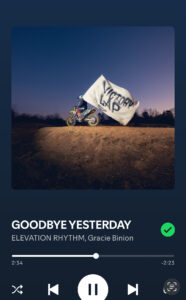
She most recently attended the Elevation Nights event with Steven Furtick and Elevation Rhythm and called it “one of the best concerts ever.”
Spencer Verlander, a freshman volleyball player majoring in sports management, has a similar story; he grew up in a Christian home that listened to Christian music as well.
Verlander started to listen to Christian music on his own because he realized the value it brought to him. “Listening to Christian music definitely puts me in a good mood and makes me think about things positively,” said Verlander.
These students are only a handful of those whose lives have been touched by Christian music and worship.
Solomon Talbott expressed his wish that other people should listen as well “because it rewires the brain.”
“Having that much positivity going into your brain rather than negativity can make a massive difference, one much bigger than most people realize,” said Talbott. “The level of intimacy and the connection that has been brought to my relationship with the Lord is profound and indescribable.”