
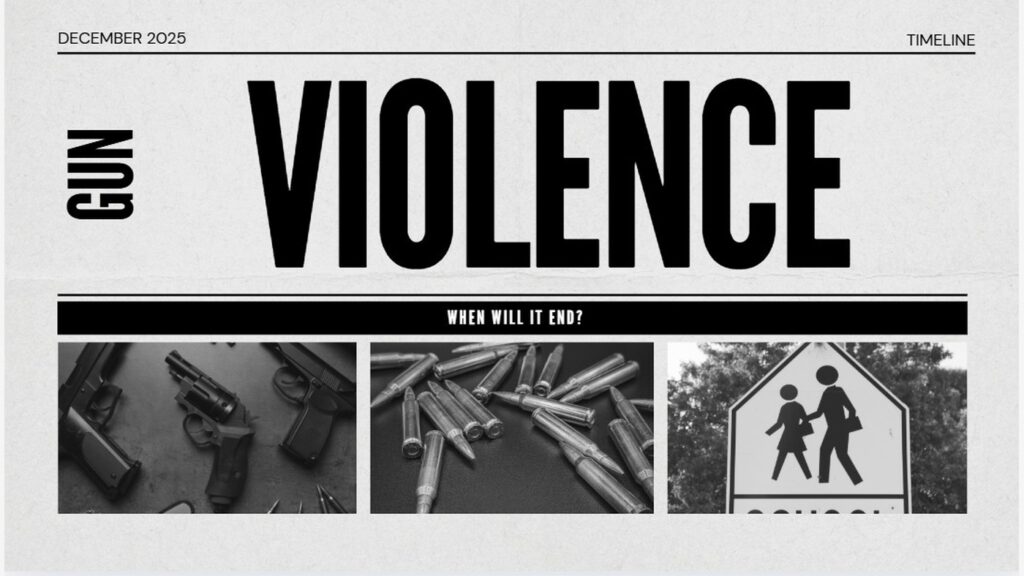

Most schools do active-shooter drills. Most workplaces will as well. For those in America, it’s no longer a once-in-a-while occurrence; it’s a way of life. Open up the news and scroll, and a story about gun violence will inevitably come up.
Columbine, Sandy Hook, Parkland, Uvalde, and, more recently, Brown University. When will it all end? What will make it end? Will stronger gun control laws? Will mental health awareness? Maybe a combination of both?
Meanwhile, children are left petrified and afraid to go to school. In fact, according to a journal article in the National Library of Medicine, 75% of students were worried about gun violence at their school. Something needs to change, but what?
Gun violence is a broad term that can be defined on multiple levels, including homicide, suicide, mass shootings, and domestic abuse.
According to Pew Research, 46,728 people in the United States died in 2023 from gun-related injuries. However, 58% of those deaths were suicides and 38% were murders. So, what is the percentage of gun deaths that are mass shootings? Depending on how you define mass shooting, the percentage is only between .22% and 1.5%.
The FBI collects data on active shooter incidents, which it defines as “one or more individuals actively engaged in killing or attempting to kill people in a populated area.”
This means that an active shooter situation could involve one shooter or multiple shooters who engage in murder or attempt to murder multiple people in an inhabited area, such as a school, church, or business.
Using this, 105 people – excluding the shooters – died in 2023. That represents the .22% noted above.
But the Gun Violence Archive, an online database of gun violence incidents in the U.S., defines mass shootings as incidents in which four or more people are shot, even if no one was killed (again excluding the shooters). Using this, 722 people died in 2023, representing the 1.5% noted above.
Regardless of the definition being used, these numbers show that fatalities in mass shooting incidents in the U.S. are a small fraction of all gun murders nationwide each year.
Where Should the Focus Be? The Mental Health Crisis or Mass Shootings?
So, are we focusing on the wrong thing? Perhaps, because suicide is by far the highest rate of gun violence in America, not shootings.
While gun control laws are in place, some people recommend stronger measures. On the federal level, gun control exists in the form of background checks, buying limitations, age restrictions, and no-gun zones. States can add additional enforcement, such as Illinois, with the FOID card.
Proponents of advanced regulation advocate for universal background checks, an assault weapons ban, secure storage laws, and more.
The Data Shows: Guns Are Connected to Suicides, Murders, and Unintentional Injuries that may occur
Multiple studies have shown that stronger regulations equal fewer deaths. Research in the American Journal of Public Health in 2024 found that permit-to-purchase (PTP) laws decreased the young adult firearm suicide rate by 39% and the overall suicide rate by 14%. Permit to Purchase laws require an individual to obtain a permit from a law enforcement agency before purchasing a gun.
When Missouri’s PTP law was repealed in 2007, it was linked to a 47% increase in gun homicide rates and a 23% increase in gun suicide rates by 2020, according to the journal.
And a 2025 study by the Johns Hopkins Center for Gun Violence Solutions reported that states with safe storage requirements saw youth suicide rates drop by up to 14%.
The RAND Corporation’s 2024–2025 review identified “supportive evidence” that child access prevention (CAP) laws reduce unintentional injuries, suicides, and violent crime.
A July 2024 study in JAMA Network Open estimated that moving from the most permissive to the most restrictive set of firearm policies is associated with a 20% reduction in overall firearm deaths.
The Question Comes Down to how People Interpret the Second Amendment
The question often boils down to the Second Amendment in the Constitution, and how it is to be read in American society today, in a time when school shootings are on the rise since the Pandemic and are a growing problem for policymakers.
While gun regulation may slow some of the growing epidemic of shootings, there certainly can be a multifaceted approach.
In fact, according to the Sandy Hook Promise, 68% of gun-related incidents at schools were guns taken from a friend, relative, or house.
In addition to this, 4.6 million children live in homes where a gun is kept loaded and unlocked, and nearly half of all parents with a weapon in the home wrongly believe their children don’t know where a gun is stored. Secure storage of firearms will prevent tragedies before they can start.
In the end, it Comes Down to Knowing the Signs
Perhaps the biggest way we can stop school shootings is to know the signs. In almost every shooter, there were documentary signs.
The teen who committed mass murder at Parkland High School in 2018 — killing 17 people and injuring 17 more — showed visible signs leading up to the attack. His social media was covered in slurs and threats, promoting violence and declaring his aspiration to become a school shooter. In fact, his threats were so serious that he was reported to the FBI.
In Uvalde, Texas, in 2022, the shooter, Salvador Ramos, killed 21 people and injured 17 more. At 18 years old, he bought an AR rifle and began posting with his guns alongside cryptic captions like “things were about go down.”
Adam Lanza, a shooter who took 28 lives at Sandy Hook Elementary School in Newtown, Connecticut, including his own, showed violent signs in his diary, and growing signs of aggression and violence in school.
Experts who worked on the report noted that “early intervention and assessment is key” to prevent these acts of violence. These are just a few of the people who have engaged in mass murder.
The majority of the plotters exhibited warning signs. Students are best positioned to identify and report concerning behaviors displayed by their classmates because friends, classmates, and other peers uncovered 69% of the plots made by another student to engage in an act of gun violence.
So Many Tragedies Are Preventable, be on High Alert
So many tragedies could be prevented. One way that people can act is through threat assessment. Each circumstance is unique, and it is essential that each school address it appropriately.
However, the weight of responsibility does not rest solely on the school. Individuals must act and be on the lookout for warning signs from their classmates. Imagine if, instead of silence, people spoke up, and a shooting was thwarted. Innocent lives would be saved.
Gun control takes a multifaceted approach. Stronger gun control laws and regulations, in conjunction with a personalized approach to each threat, need to be enacted.
This could look like PTP laws, FOID cards, and a 3-day waiting period to buy firearms, and more. In schools, it could mean active counseling and training for both faculty and students to recognize the signs and be encouraged to report them, no matter how small. Many schools are already doing this, and more should be encouraged to join the effort.
It could mean, when there is a threat, dealing with it with the severity and seriousness it requires, but also with the humanity of one person to another, and finding out the why behind the action or potential action.
Guns are a part of our Constitution, and for some, they’re a way of life. The most important action is to remain aware. Safety comes from awareness. It takes each individual. It takes our generation to stand up and make it better for those to come.
Some people may not know the topic of gun violence and the debate over regulations. But when an intruder comes, and a place goes into lockdown, it can be a scary situation. And every day, millions of people may live in that same fear, afraid it might happen to them. Shootings, murders, and suicides are all preventable. Know the signs and speak up because tomorrow, it may not be just a story on the news, it may be a story that involves you.