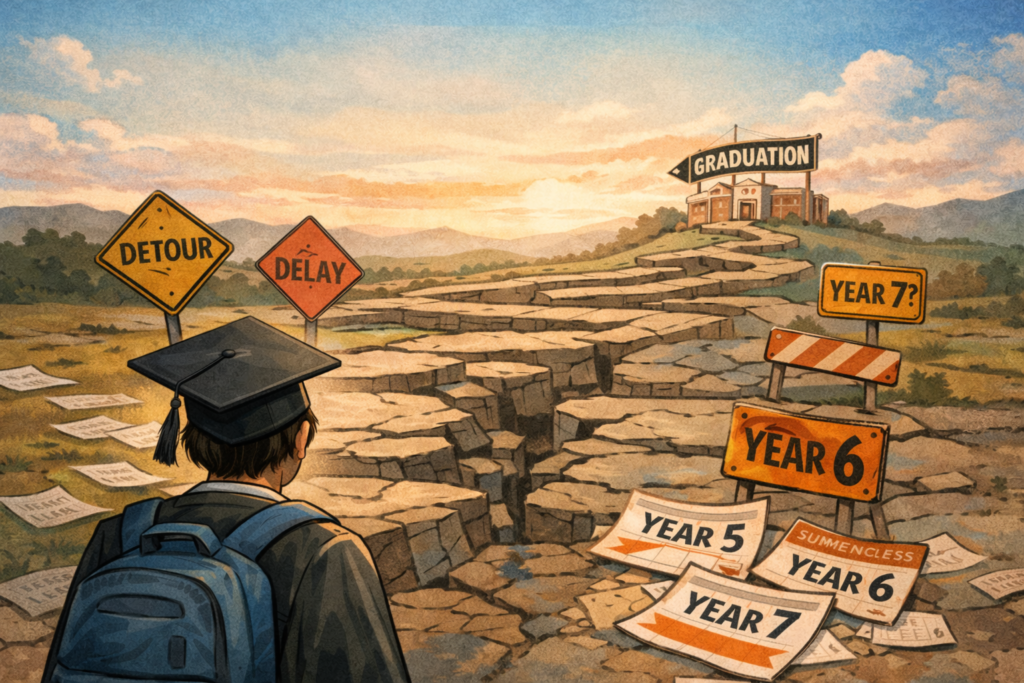

Why college students feel pressure to graduate on time—and why they shouldn’t.
In high school, students are indoctrinated with the belief that the path to success is linear: attend a university, graduate in four years and land a full-time job.
When life intervenes and disrupts this plan, however, many students are left feeling ashamed and inadequate.
The truth is, they are not alone. In fact, they are part of the majority.
According to the U.S. Department of Education, “fewer than half of students at four-year colleges graduate within four years.”
Further yet, less than two-thirds of these students will graduate even after six years.
Despite these odds, NBC News reported that 9 in 10 college freshmen are confident they will earn their degree in four years or less.
What accounts for this significant disconnect?
A 2021 study published in Research in Higher Education found five main factors that can delay a college student’s trajectory.
First, federal regulations allow students taking 12 credits per semester, rather than 15, to be considered full time, making them eligible for maximum financial aid.
However, research indicates that modern bachelor’s programs require an average of 133.5 credits, rather than the traditional 120, which MBU follows.
This leads students to believe they can take the bare minimum course load and still graduate on time.
Mathematically, this is impossible, as eight semesters of 12 credit hours totals only 96.
Even an additional year would leave students more than 13 credits below the national average.
Second, about 40% of undergraduates are required to take noncredit developmental courses at the start of their college careers.
Often due to low test scores or GPA, these courses help underprepared students transition to a higher academic environment.
Third, about 13% of university students interrupt their enrollment within the first three years.
Whether financial stress or family responsibilities, it is not uncommon for students to temporarily step away from college life.
I know this firsthand because I was one of them.
After an unexpected health crisis, I was forced to move home from an out-of-state university.
Unsure what to do next, I decided to take a gap year to focus on healing and reevaluating my future.
At the time, I felt isolated and inadequate; my peers seemed to be thriving while I was a full year behind.
Looking back, that year saved my life and led me to where I am now—a healthy and successful student at Missouri Baptist University.
Now, I know I’m not the only one.
In 2024, the National Student Clearinghouse Research Center found that transfer enrollment increased by 7.9% since 2020, marking its third consecutive year of growth.
Currently, transfer students account for roughly 13% of the non-freshmen undergraduate population.
Why does this matter?
Because transferring is rarely an easy process and comes with various challenges.
Different universities hold different standards, so credit hours are often lost in translation.
This leaves students repeating courses and adding on requirements that ultimately delay their academic progress.
Lastly, switching majors has become the norm in recent years.
According to the National Center for Education Statistics, around 80% of college students change their major at least once.
Not only this, but the average student switches at least three times throughout their academic career.
This reality contradicts the expectation that high schoolers must have their career path mapped out before graduation.
As the Student Research Group explains, students change majors for a variety of reasons
Expectations do not align, interests evolve, career outlooks differ and courseloads can be too difficult to handle.
These experiences are completely normal and nothing to be ashamed of.
In fact, the public outlook on higher education itself is gradually shifting.
The ECMC Group found that the “number of high schoolers considering a four-year degree has dropped 23 percentage points” since 2020, now standing at 48%.
Since the pandemic, younger generations have taken a more creative approach to education and the workforce.
Rather than the traditional four-year plan, “Gen Z wants skill-focused, quicker pathways to careers.”
Clearly, there is no single path to educational or financial success.
As these statistics have proven, academic norms are constantly evolving with each generation.
For those who feel their college experience has been interrupted, delayed or altogether inadequate, know that you are not alone.
Additional semesters, failed classes, gap years and transfers are not atypical; what may feel like a setback is often the turning point in a student’s journey.
The “number of high schoolers considering a four-year degree has dropped 23 percentage points” since 2020, now standing at 48%
ECMC Group Tweet