
Last winter’s Code Blue response program brought shelter to hundreds of unhoused individuals in the St. Louis area. However, inconsistent funding has raised questions about the program’s sustainability. Board Bill No. 91 proposes using revenue from the city’s marijuana sales tax to support the initiative and ensure that safe shelter remains accessible to those in need.
As temperatures drop and winter approaches in St. Louis, the need for emergency shelter is growing. Yet the future of funding for the city’s cold-weather response program remains uncertain.
The St. Louis City Continuum of Care (CoC), a large group of service providers committed to serving the homeless population, reported over 2,000 unhoused individuals in the City of St. Louis this August, with roughly 600 facing long-term displacement.
In November 2025, St. Louis Mayor Cara Spencer issued an executive order to activate “Code Blue,” an emergency response program designed to serve the homeless community amid dangerously cold weather.
The initiative made a significant impact. According to the After Action Review (AAR), the 2025-26 Code Blue funds were “sufficient to shelter most of the individuals who requested emergency shelter during the winter months.”
The program added over 700 overflow shelter beds, provided transportation for more than 500 individuals and expanded accommodations for individuals with unique circumstances.
Last winter, Code Blue received $3.36 million dollars, largely funded through the Rams settlement. This year, however, the city has allocated $2 million from its general budget.
Board Bill No. 91
A St. Louis Board of Aldermen committee is pushing for new legislation to provide consistent and reliable funding for Code Blue.
On Oct. 9, 2026, 7th Ward Alderwoman Alisha Sonnier introduced Board Bill No. 91 to members of the Health and Human Development Committee.
St. Louis Public Radio said the bill “calls for using the city’s 3% tax on marijuana sales to pay for the emergency shelter, transport and outreach.”
If approved, the emergency weather response program could receive an additional $1.5 million for shelter, transportation and outreach services for unhoused individuals in the community.
In January 2025, the St. Louis City Continuum of Care reported that 469 households were turned away due to lack of space and resources. Meanwhile, emergency shelter utilization reached 112% of its capacity, according to Homeless Management Information System (HMIS) data.
Emergency resources should not remain a year-to-year uncertainty due to inconsistent funding. This dedicated financial support would not only allow organizations to plan ahead but ensure that St. Louis residents feel safe, valued and taken care of.
Current Status
Board Bill No. 91 awaits final passage after reaching the perfection stage on Friday, Nov. 6.
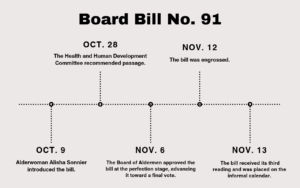
The Board of Aldermen must approve the bill through final passage before it can proceed toward becoming law.
Although Code Blue is set to officially begin Tuesday, Dec. 1, sudden temperature drops in early November prompted some emergency shelters to activate ahead of schedule.
In a recent interview with First Alert 4, CoC Director Jonathon Belcher called for public support through donations and volunteer efforts.
For those looking to get involved, several local organizations offer opportunities to support individuals experiencing homelessness.
Local Shelters and Volunteer Resources